



Warehouse and Logistic Optimization
Optimise Warehouse Space. Streamline Material Movement. Reduce Logistics Costs.
We help manufacturers optimise warehouse operations through Lean warehousing, storage planning and internal logistics improvement. From warehouse layout and space utilisation to inventory movement, material handling and dispatch management, we create efficient warehouse systems that reduce operating costs, improve inventory accessibility and enhance supply chain performance.

Warehouse & Logistics Optimisation for Manufacturing
Universal Edge Services (UES) optimizes warehouse operations and logistics through structured storage planning and material handling.
We assess material characteristics and workflows to design practical systems that improve space utilization and order fulfillment.
Our Warehouse & Logistics Optimisation Services
1. Warehouse Layout & Storage Optimisation
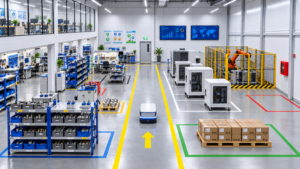
Design warehouse layouts that use available space effectively while maintaining safe access and efficient material flow.
- Assess storage capacity, SKU profiles, dimensions, movement and access requirements.
- Plan storage zones, racking, shelving, floor storage and staging areas.
- Improve slotting and location allocation based on movement frequency and material characteristics.
- Optimise receiving, storage, picking, packing and dispatch areas.
2. Warehouse Process & Inventory Control
Establish standard warehouse workflows that improve inventory accuracy, traceability and transaction discipline.
- Standardise receiving, inspection, put-away, picking, packing and dispatch processes.
- Improve location identification, labelling, FIFO and stock rotation.
- Strengthen cycle counting, stock reconciliation and inventory accuracy.
- Define warehouse KPIs, standard work and visual controls.
3. Material Handling & Internal Logistics
Reduce unnecessary movement and handling through better equipment, route and replenishment planning.
- Assess forklift, pallet truck, trolley and conveyor requirements.
- Optimise travel paths, picking routes and material transfer points.
- Develop replenishment and line-feeding systems for production warehouses.
- Improve loading, unloading and staging practices.
4. Transportation, Dispatch & Distribution Optimisation
Improve outbound logistics performance by planning transport resources, dispatch processes and delivery routes.
- Review vehicle utilisation, load consolidation and dispatch frequency.
- Improve shipment planning, vehicle scheduling and dock coordination.
- Evaluate route planning and delivery consolidation opportunities.
Our Project Execution Methodology
- Assess: Study warehouse layout, SKU profile, inventory, throughput, workflows and logistics costs.
- Classify: Identify space constraints, process delays, excess movement, handling losses and transport inefficiencies.
- Parameterise: Develop optimised storage, material handling, warehouse workflow and logistics solutions.
- Implement: Deploy layout changes, standard work, visual controls and performance measures in practical phases.
- Sustain: Monitor warehouse and logistics KPIs, review gaps and drive continuous improvement.
Expected Business Outcomes
UES helps establish measurable indicators to monitor warehouse and logistics performance:
- Warehouse space utilisation and storage density.
- Inventory accuracy, stock ageing and picking accuracy.
- Order picking, packing and dispatch cycle time.
- Material handling distance and movements per order.
- Vehicle fill rate, load utilisation and delivery adherence.
- Freight cost per shipment, unit or tonne-kilometre, as relevant.
- Order fulfilment rate and on-time dispatch performance.
Why Choose Universal Edge Services
- Manufacturing-focused: Warehouse and logistics solutions aligned with production, inventory and customer delivery requirements.
- End-to-end perspective: Integrate inbound, storage, internal movement, picking, dispatch and outbound logistics.
- Lean approach: Reduce non-value-added movement, waiting, excess handling and inefficient storage.
- Implementation-oriented: Practical recommendations supported by workflows, layout planning, ownership and measurable KPIs.