


Material Flow Management
Optimise Material Movement. Reduce Handling. Improve Production Flow.
We help manufacturers streamline material flow through Lean material handling systems, internal logistics planning and workflow optimisation. From raw material movement to work-in-progress and finished goods, we design efficient flow systems that minimise material handling, reduce lead times and improve overall operational productivity.

Factory Material Flow Management & Optimisation
Create Seamless Material Flow. Reduce WIP. Accelerate Manufacturing Throughput.
Inefficient material movement, excessive work-in-progress (WIP), disconnected production processes and unnecessary transportation increase manufacturing costs and extend delivery lead times.
At Universal Edge Services (UES), we help manufacturers optimise material flow from raw material receipt to finished goods dispatch. By combining Lean manufacturing principles, factory layout optimisation and internal logistics planning, we create streamlined material flow systems that minimise handling, reduce waiting time and improve production throughput.
Whether you are establishing a new factory, expanding an existing facility or improving an operational manufacturing plant, UES develops practical material flow solutions aligned with your production requirements.
Our Factory Material Flow Optimisation Services
- Current-State Material Flow Assessment
We analyse existing material movement, production sequences, storage locations and interdepartmental transfers to identify inefficiencies and bottlenecks.
- Map existing material flow from RM to FG.
- Identify unnecessary transportation, backtracking and cross-movement.
- Analyse WIP accumulation and waiting points.
- Measure material movement distances and handling frequency.
- Identify process bottlenecks and disconnected operations.
Deliverable: Current-state material flow map and improvement opportunity assessment.
- Future-State Material Flow Design
We develop an optimised material flow system that connects processes logically and supports continuous production.
- Design sequential and streamlined production flow.
- Optimise department positioning and process connectivity.
- Develop material flow diagrams and spaghetti diagrams.
- Establish point-of-use material storage.
- Align production layout with material replenishment requirements.
Deliverable: Future-state material flow design and implementation recommendations.
- Internal Logistics & Material Handling Optimisation
We improve how materials are transported, stored and replenished across the factory to minimise non-value-added movement.
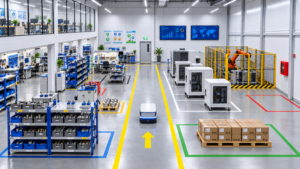
- Optimise forklift, trolley and pedestrian movement routes.
- Design milk-run and tugger-based material delivery systems where suitable.
- Establish supermarket and line-side material supply systems.
- Optimise loading, unloading and interdepartmental transfer points.
- Reduce unnecessary material handling and transportation.
Deliverable: Internal logistics plan and material replenishment strategy.
- WIP & Inventory Reduction
Excessive WIP increases working capital, occupies valuable floor space and hides production problems. We implement Lean material flow practices to establish controlled inventory levels.
- Identify excess and ageing WIP.
- Establish FIFO lanes and controlled buffer zones.
- Implement Kanban and pull-based replenishment.
- Optimise batch sizes and production transfer quantities.
- Improve coordination between stores, production and dispatch.
Deliverable: WIP reduction roadmap and inventory control recommendations.
- Production Flow & Throughput Time Improvement
We improve the connection between manufacturing processes to reduce waiting time and accelerate order fulfilment.
- Identify bottleneck operations and process constraints.
- Improve production line balancing and process synchronisation.
- Optimise transfer batch sizes.
- Reduce queue time between operations.
- Align material availability with production schedules.
Deliverable: Production flow improvement plan with measurable performance indicators.
Our Approach
UES follows a structured Lean methodology to optimise material flow:
- Assess: Study existing factory layout, production processes and material movement.
- Analyse: Identify bottlenecks, excess handling, WIP accumulation and non-value-added transportation.
- Design: Develop future-state material flow and internal logistics solutions.
- Implement: Support layout modifications, replenishment systems and process improvements.
- Monitor: Track improvements in material movement, WIP, throughput time and production flow.
Why Choose UES for Factory Material Flow Management?
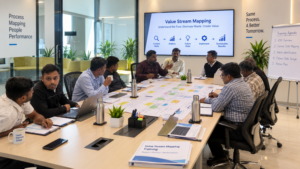
- Lean Manufacturing Expertise: Practical application of VSM, Kanban, FIFO, pull systems and continuous flow principles.
- End-to-End Perspective: Material flow optimisation covering stores, production, quality, warehouse and dispatch.
- Layout Integration: Solutions aligned with greenfield factory planning, brownfield expansion and existing factory optimisation.
- Implementation-Focused: Recommendations designed around actual operating conditions, not just theoretical layouts.
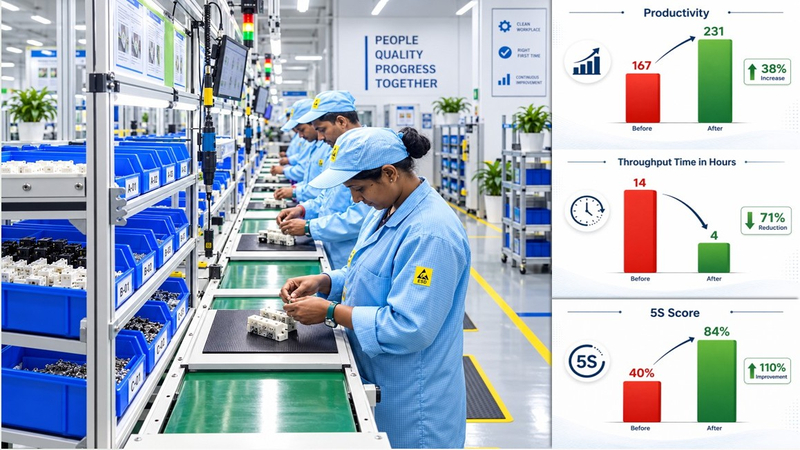
- Measurable Improvements: Focus on reducing material movement, WIP, waiting time and manufacturing lead time.
Measurable Business Outcomes
Our objective is to create a manufacturing environment where the right material reaches the right process, at the right time, with minimum handling and waiting.
- Improvement area: Reduced transportation and handling effort
- Material handling: Reduced transportation and handling effort
- Throughput time: Faster production order completion
- Waiting time: Improved process continuity
- WIP inventory: Lower inventory and working capital
- Floor space: Better utilisation of production and storage areas
- Production flow: Improved coordination between processes
Actual improvement opportunities and targets are established after assessing the existing manufacturing system.