
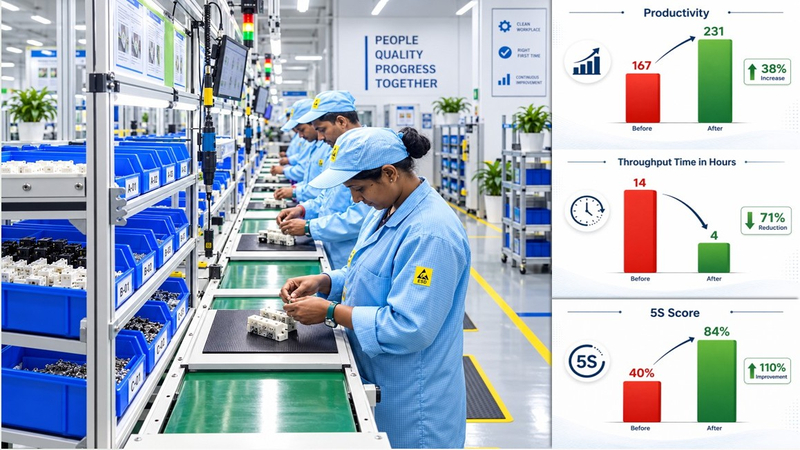
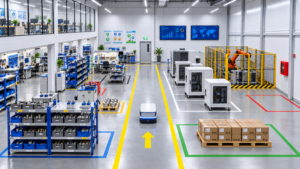
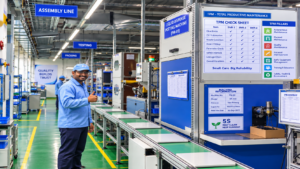

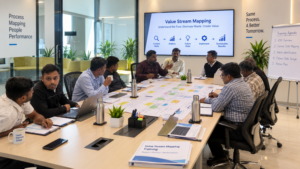
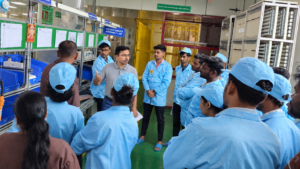
Productivity Improvement
Drive higher manufacturing productivity through OEE improvement, cycle time reduction, setup time optimization, manpower utilization, resource productivity and 5S workplace organization. UES delivers practical Lean Manufacturing solutions that improve output, efficiency and operational performance.

OEE Improvement Consulting
MAXIMISE EQUIPMENT EFFECTIVENESS
Improve Machine Performance. Unlock Hidden Production Capacity.
Equipment downtime, frequent breakdowns, speed losses and quality defects restrict manufacturing capacity and increase production costs. Improving Overall Equipment Effectiveness (OEE) helps manufacturers get more productive output from their existing machines and equipment.
At Universal Edge Services, we help organizations identify and eliminate equipment-related losses through systematic OEE assessment, Total Productive Maintenance (TPM) and focused improvement initiatives. Our approach addresses equipment availability, performance and quality to improve overall manufacturing effectiveness.
Our Approach
OEE Assessment: Establish baseline OEE and identify major equipment losses.
Availability Improvement: Reduce breakdowns, unplanned stoppages and equipment downtime.
Performance Improvement: Eliminate minor stoppages, speed losses and inefficient machine operation.
Quality Improvement: Reduce machine-related defects, rework and startup rejections.
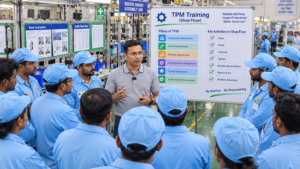
TPM Implementation: Strengthen Autonomous Maintenance, Planned Maintenance and Focused Improvement.
Performance Monitoring: Establish OEE dashboards, loss tracking and daily review systems.
Expected Outcomes
Higher equipment availability and utilisation.
Reduced breakdowns and production interruptions.
Improved machine productivity and throughput.
Reduced manufacturing costs per unit.
Increased production capacity without unnecessary capital investment.
Setup Time Reduction
FASTER CHANGEOVERS | GREATER PRODUCTION FLEXIBILITY
Minimize Changeover Time | Maximize Productive Machine Hours
Frequent product changes, lengthy machine setups and adjustments reduce productive manufacturing time. These losses become particularly significant in high-mix, low-volume manufacturing environments where machines undergo frequent changeovers.
UES helps organisations reduce setup and changeover times through Single Minute Exchange of Die (SMED), setup activity analysis and standardisation. We focus on simplifying changeover activities, separating internal and external setup operations and improving the readiness of tools, materials and equipment.
Our Approach
Setup Time Analysis: Study existing setup activities and establish baseline changeover times.
SMED Implementation: Separate internal and external setup activities and convert suitable internal activities into external ones.
Activity Simplification: Eliminate unnecessary adjustments, movements and repetitive activities.
Tooling & Fixture Optimisation: Improve accessibility, positioning and quick-change arrangements.
Setup Standardisation: Develop standard setup procedures, checklists and visual instructions.
Operator Training: Build skills for consistent and repeatable changeovers.
Expected Outcomes
Reduced machine changeover and setup time.
Increased available production time.
Improved machine utilisation.
Smaller economical production batches.
Greater flexibility in responding to changing customer demand.
Manpower Optimisation
OPTIMISE WORKFORCE | IMPROVE LABOUR PRODUCTIVITY
Right People | Right Work | Optimal Manpower Utilization.
Inefficient manpower deployment, uneven workloads, excessive operator movements and poorly designed workstations can result in higher labour costs without corresponding improvements in production output.
UES helps manufacturers optimise workforce utilisation through systematic manpower assessment, work measurement, line balancing and operator allocation studies. Our focus is to improve productivity by eliminating non-value-added activities, balancing workloads and deploying manpower effectively without compromising quality, safety or operational stability.
Our Approach
Manpower Assessment: Evaluate existing manpower deployment against production requirements.
Work Measurement: Conduct time studies and determine standard times for operations.
Manpower Loading: Analyse workload distribution and identify underutilised or overloaded resources.
Line Balancing: Optimise operator allocation across production workstations.
Multi-Skilling: Develop operator flexibility through skill matrix and cross-training.
Method Improvement: Reduce unnecessary handling, movement and waiting activities.
Expected Outcomes
Improved output per employee.
Optimised manpower deployment.
Reduced idle time and workload imbalance.
Improved labour cost per unit.
Greater workforce flexibility and operational efficiency.
Resource Productivity
MAXIMISE UTILISATION OF EXISTING RESOURCES
Get More from Your Existing Resources | Improve Operational Efficiency
Manufacturing productivity depends on the effective utilisation of all available resources, including machines, manpower, materials, energy and factory infrastructure. Underutilised resources, excessive consumption and inefficient resource allocation increase operational costs and restrict business performance.
UES helps organisations identify productivity gaps and improve the utilisation of existing resources through Industrial Engineering, Lean Manufacturing and systematic resource productivity assessments.
Our Approach
Resource Utilisation Study: Assess the utilisation of machines, manpower, materials and infrastructure.
Capacity Analysis: Compare available capacity with actual production requirements.
Material Utilisation: Identify material losses, excess consumption and handling inefficiencies.
Energy Productivity: Identify opportunities to reduce energy consumption per unit of output.
Workstation & Space Utilisation: Improve utilisation of available floor space, equipment and workstations.
Productivity Measurement: Establish KPIs to monitor resource utilisation and output efficiency.
Expected Outcomes
Higher output from existing resources.
Improved machine and workforce utilisation.
Reduced resource wastage and operating costs.
Better capacity utilisation.
Improved productivity per unit of resource consumed.
5S & Workplace Organisation
ORGANISE | STANDARDISE | SUSTAIN
Create Organized, Efficient, Safe and Productive Workplaces.
Disorganized workplaces, excessive material accumulation, poor storage practices and inefficient workplace layouts lead to unnecessary movement, longer search times, safety risks and productivity losses.
UES helps manufacturing organizations establish structured workplace organization through the 5S methodology and Visual Management Systems. We go beyond housekeeping by creating systematic workplace standards that improve accessibility, process discipline, safety and employee ownership.
Our Approach
Sort (Seiri): Identify and remove unnecessary items from work areas.
Set in Order (Seiton): Organise tools, materials and equipment for easy identification and retrieval.
Shine (Seiso): Establish cleaning and inspection practices to maintain workplace conditions.
Standardize (Seiketsu): Develop visual standards, checklists and workplace organisation procedures.
Sustain (Shitsuke): Build employee ownership through audits, reviews and continuous improvement.
Visual Management: Implement visual controls, floor markings, shadow boards, identification systems and workplace standards.
Expected Outcomes
Improved workplace organization and cleanliness.
Reduced material search and retrieval time.
Improved workplace safety and accessibility.
Reduced unnecessary movement and handling.
Stronger employee ownership and discipline.
Sustainable workplace improvement culture.
Process Optimisation
ELIMINATE WASTE. SIMPLIFY PROCESSES | IMPROVE FLOW
Redesign Processes for Better Productivity and Performance
Inefficient process sequences, unnecessary handling, excessive work-in-progress, duplicated activities and poor material flow increase manufacturing lead times and operating costs.
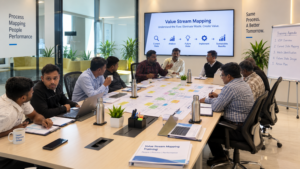
UES helps manufacturers optimise end-to-end processes by identifying non-value-added activities, eliminating process inefficiencies and establishing streamlined workflows. We apply Lean Manufacturing, Value Stream Mapping, Process Mapping and continuous improvement methodologies to improve process performance across manufacturing operations.
Our Approach
Current-State Assessment: Study existing processes, workflows and material movement.
Value Stream Mapping: Identify value-added and non-value-added activities across the value stream.
Waste Elimination: Address the seven forms of manufacturing waste, including waiting, transportation, motion and overprocessing.
Process Flow Improvement: Simplify process sequences, reduce unnecessary handling and improve material flow.
Single-Piece Flow: Develop continuous and synchronised production flows wherever feasible.
Standardisation: Establish optimised workflows, operating procedures and performance monitoring systems.
Expected Outcomes
Reduced process lead time and throughput time.
Improved material and information flow.
Reduced work-in-progress and unnecessary handling.
Higher process efficiency and productivity.
Improved quality and delivery performance.
Sustainable process improvement.