

Delivery Improvement Consulting
Improve delivery performance, accelerate production flow and reduce lead times through systematic workflow optimisation. UES helps manufacturers eliminate bottlenecks, implement single-piece flow, optimise production schedules and improve on-time delivery to achieve faster order fulfilment and greater operational efficiency.

Single-Piece Flow
IMPROVE PRODUCTION FLOW | REDUCE WAITING TIME
Move from Batch Production to Continuous Flow
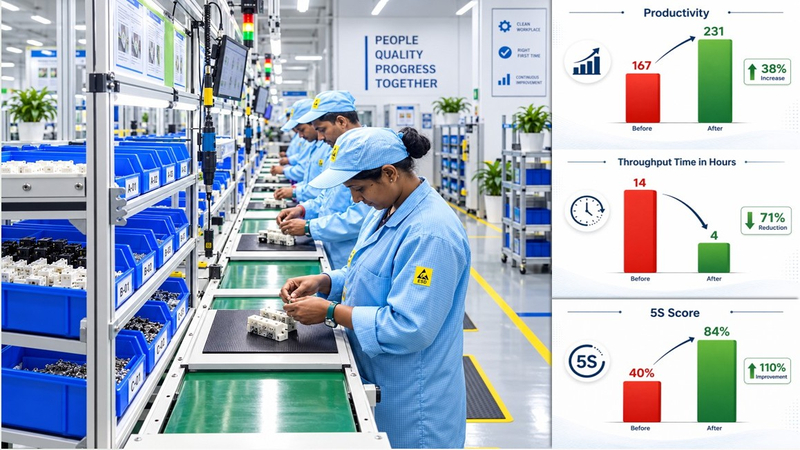
Large production batches, excessive work-in-progress and disconnected operations create unnecessary waiting time and increase manufacturing lead times. Products often spend more time waiting between operations than being processed, delaying order completion and customer deliveries.
UES helps manufacturers implement Single-Piece Flow by synchronising production operations, balancing workloads and eliminating unnecessary material movement. Our approach focuses on establishing continuous production flow wherever technically and economically feasible.
Our Approach
Current-State Flow Assessment: Analyse existing production sequences, material movement and waiting time between operations.
Batch Size Optimisation: Identify opportunities to reduce batch sizes and move towards smaller production lots.
Line Balancing: Distribute workloads across workstations based on takt time and customer demand.
Workstation Synchronisation: Align process cycle times to establish smoother production flow.
WIP Control: Introduce FIFO lanes, WIP limits and controlled material transfer between operations.
Standard Work: Establish standardised operating sequences to maintain consistent production flow.
Expected Outcomes
Reduced work-in-progress inventory.
Shorter manufacturing lead times.
Reduced waiting time between operations.
Improved production throughput.
Faster order completion.
Better production flow and delivery responsiveness.
Bottleneck Elimination
REMOVE CONSTRAINTS | INCREASE THROUGHPUT
Identify Production Constraints | Unlock Manufacturing Capacity
Production bottlenecks restrict the flow of materials, create queue accumulation and delay order completion. A constraint at even one operation can affect the throughput of the entire production system, resulting in missed delivery commitments and increased work-in-progress.
UES helps manufacturers identify, analyse and eliminate production bottlenecks using constraint analysis, capacity assessment and focused improvement methodologies. We focus on improving the performance of constraint operations to increase overall system throughput.
Our Approach
Bottleneck Identification: Identify constraint operations through cycle time studies, capacity analysis and production data.
Constraint Analysis: Evaluate machine capacity, manpower availability, setup losses and process-related restrictions.
Theory of Constraints: Apply the Five Focusing Steps to identify, exploit, subordinate and elevate constraints.
Capacity Improvement: Improve constraint operations through method improvement, setup reduction and resource optimisation.
Production Synchronisation: Align upstream and downstream processes with constraint capacity.
Continuous Monitoring: Establish throughput, queue time and bottleneck performance indicators.
Expected Outcomes
Increased production throughput.
Reduced bottleneck-related waiting time.
Improved utilisation of constraint resources.
Reduced WIP accumulation.
Shorter production lead times.
Improved order fulfilment performance.
Factory Flow Optimisation
STREAMLINE MATERIAL MOVEMENT | CREATE EFFICIENT FACTORY FLOWS
Design Manufacturing Layouts for Smooth Material Flow
Poor factory layouts, excessive transportation distances, backtracking and disconnected production areas increase material handling time and disrupt manufacturing flow. Inefficient movement of materials between stores, production operations and dispatch can significantly affect overall delivery performance.
UES helps manufacturers optimise factory layouts and material flow by analysing existing facility arrangements, production sequences and material movement patterns. Our approach integrates Lean Layout Design, Spaghetti Diagrams, Value Stream Mapping and material flow analysis to establish efficient manufacturing environments.
Our Approach
Factory Flow Assessment: Study existing layouts, material routes, production sequences and movement patterns.
Spaghetti Diagram Analysis: Identify unnecessary transportation, backtracking and excessive movement.
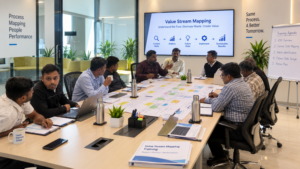
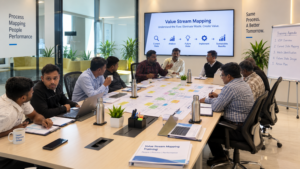
Value Stream Mapping: Analyse material and information flow to identify delays and non-value-added activities.
Layout Optimisation: Develop improved factory layouts based on process sequence, material flow and operational requirements.
Material Handling Improvement: Optimise material movement systems, transfer methods and point-of-use material availability.
Stores & Warehouse Flow: Improve raw material storage, WIP locations, finished goods storage and dispatch flow.
Expected Outcomes
Reduced material transportation time.
Improved factory space utilisation.
Reduced material handling and movement.
Smoother production flow.
Reduced congestion and backtracking.
Improved manufacturing lead times.
Throughput Time Reduction
REDUCE WAITING | ACCELERATE PRODUCTION COMPLETION
Convert Manufacturing Time into Productive Flow
Long throughput times are often caused by excessive waiting, large batch sizes, process bottlenecks, unnecessary inspections and inefficient production sequencing. These delays increase WIP, extend order completion time and reduce the organisation’s ability to respond to customer demand.
UES helps manufacturers reduce throughput time by analysing the complete production journey, identifying non-value-added time and improving the flow of materials across operations. Our focus is to shorten the time taken for products to move from production start to completion.
Our Approach
Throughput Time Study: Measure total production time, including processing, waiting, movement and inspection.
Value-Added Analysis: Differentiate value-added processing time from non-value-added activities.
Queue Time Reduction: Identify and eliminate excessive waiting between manufacturing operations.
Batch Size Reduction: Optimise production lot sizes to improve flow and reduce delays.
Process Synchronisation: Align production operations and material transfer schedules.
Performance Monitoring: Establish throughput time KPIs and track improvements across production stages.
Expected Outcomes
Reduced manufacturing throughput time.
Faster production order completion.
Lower work-in-progress inventory.
Improved production responsiveness.
Reduced waiting and queue time.
Better utilisation of manufacturing capacity.
Product Lead Time Reduction
SHORTEN CUSTOMER LEAD TIMES | RESPOND FASTER TO DEMAND
Deliver Products Faster | Improve Customer Responsiveness
Long product lead times, delayed material procurement, inefficient production planning and extended order processing cycles affect customer satisfaction and business competitiveness. Delays across procurement, manufacturing, inspection and dispatch can significantly increase the time between order receipt and product delivery.
UES helps manufacturers reduce end-to-end product lead times by improving coordination across procurement, production, quality and dispatch functions. We focus on eliminating delays across the complete order fulfilment process.
Our Approach
Lead Time Assessment: Map the complete order-to-delivery cycle, including procurement, production and dispatch.
Value Stream Mapping: Identify delays, waiting periods and non-value-added activities across the value stream.
Material Availability: Improve material planning, procurement coordination and supplier delivery performance.
Production Planning Improvement: Align production schedules with customer priorities and material availability.
Order Fulfilment Optimisation: Streamline order processing, production release, inspection and dispatch activities.
Lead Time Monitoring: Establish order lead time KPIs and monitor performance against customer commitments.
Expected Outcomes
Reduced order-to-delivery lead time.
Faster customer order fulfilment.
Improved coordination across departments.
Reduced production and procurement delays.
Better responsiveness to changing customer demand.
Improved customer satisfaction.
On-Time Delivery Improvement
MEET CUSTOMER COMMITMENTS | IMPROVE DELIVERY RELIABILITY
Improve On-Time Delivery Through Better Planning and Execution
Poor production planning, material shortages, machine breakdowns, capacity constraints and ineffective order tracking can result in missed delivery commitments. Even when individual departments achieve their targets, a lack of coordination across the manufacturing value chain can affect overall On-Time Delivery (OTD) performance.
UES helps manufacturers improve OTD by strengthening production planning, material readiness, shop-floor execution and dispatch coordination. We establish systematic order tracking and visual performance management to identify delivery risks early and ensure timely corrective action.
Our Approach
OTD Performance Assessment: Analyse historical delivery performance, overdue orders and reasons for delays.
Order Prioritisation: Establish systematic order prioritisation based on customer commitments and business requirements.
Production Planning: Improve production scheduling, capacity planning and order release systems.
Material Readiness: Ensure timely availability of raw materials, components and bought-out parts.
Daily Delivery Monitoring: Establish daily production and dispatch reviews with order-level tracking.
Visual Delivery Management: Implement order status dashboards, overdue order tracking and escalation mechanisms.
Expected Outcomes
Improved On-Time Delivery performance.
Reduced overdue customer orders.
Better production schedule adherence.
Improved coordination between planning, stores and production.
Faster identification of delivery risks.
Increased customer confidence and satisfaction.
Heijunka Implementation
LEVEL PRODUCTION | STABILISE FLOW
Balance Production with Customer Demand. Reduce Planning Variability
Unbalanced production schedules, fluctuating workloads and large production batches create uneven resource utilisation, excessive inventory and delivery inconsistencies. Producing too much of one product while delaying another can disrupt the entire production system.
UES helps manufacturers implement Heijunka (Production Levelling) to balance production volume and product mix in line with customer demand. By establishing more consistent production schedules, we help organisations reduce workload fluctuations, improve resource utilisation and create predictable manufacturing flows.
Our Approach
Demand Pattern Analysis: Analyse customer demand, order frequency, product mix and volume variations.
Production Levelling: Develop production schedules that balance demand across available production capacity.
Product Mix Optimisation: Establish appropriate sequencing of different products to improve production stability.
Pitch & Scheduling: Develop practical production intervals and scheduling mechanisms based on demand.
Capacity Alignment: Balance workloads across machines, workstations and production teams.
Production Monitoring: Establish visual production schedules and adherence monitoring systems.
Expected Outcomes
More consistent production schedules.
Reduced production workload fluctuations.
Improved product mix management.
Reduced excess finished goods inventory.
Better utilisation of production resources.
Improved delivery reliability and responsiveness.
Production Workflow Management
CONNECT PLANNING WITH EXECUTION | CONTROL PRODUCTION FLOW
Establish Controlled Production Workflows | Improve Schedule Adherence
Disconnected planning systems, unclear production priorities, delayed work order releases and poor shop-floor visibility can disrupt production execution. Without effective workflow management, manufacturers struggle to track order progress, identify delays and coordinate activities across departments.
UES helps manufacturers establish structured production workflow management systems that connect production planning, material availability, shop-floor execution and dispatch. Our focus is to improve visibility, accountability and control across the complete production process.
Our Approach
Workflow Assessment: Map existing production planning, order release and shop-floor execution processes.
Production Scheduling: Establish systematic production schedules based on demand, capacity and material availability.
Work Order Management: Improve work order release, prioritisation and tracking mechanisms.
Production Control: Implement daily production monitoring, schedule adherence tracking and exception management.
Visual Management Systems: Establish production boards, order status tracking and escalation mechanisms.
Cross-Functional Coordination: Strengthen coordination between sales, planning, procurement, stores, production, quality and dispatch.
Expected Outcomes
Improved production schedule adherence.
Better visibility of order status and production progress.
Reduced production delays.
Improved departmental coordination.
Faster identification and resolution of constraints.
More reliable customer delivery commitments.